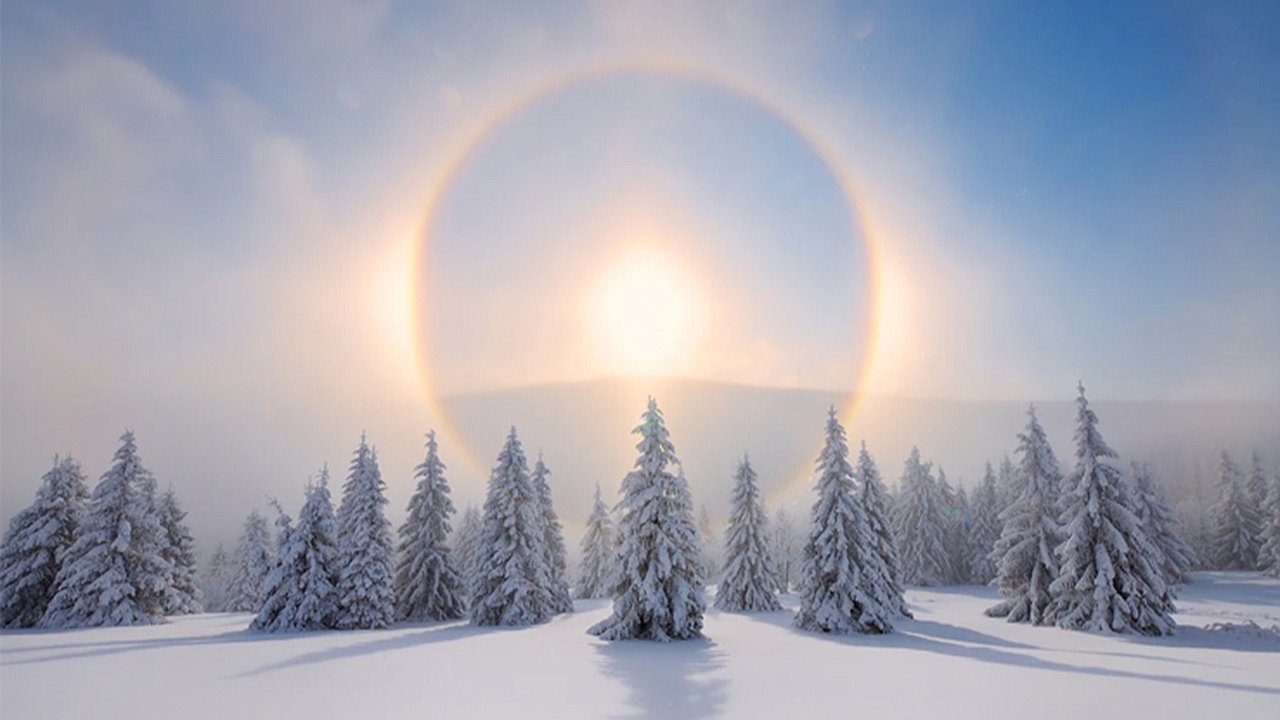
If you live in a place where you can see the sun—and let’s face it, that’s most of us—you’re in the perfect position to catch a glimpse of some truly magical optical displays right above your head. These daytime delights include radiant halos, glowing arcs, and rainbow-like rings that seem to hover in the sky. Collectively known as atmospheric optical phenomena, these effects are usually the result of sunlight interacting with tiny ice crystals suspended in the atmosphere. The real stars of this show? Hexagonal ice crystals. These naturally occurring structures float in high, cold air layers—even in summer—and reflect and refract sunlight in spectacular ways. During winter, when temperatures plunge even at lower altitudes, these displays become especially vivid and frequent.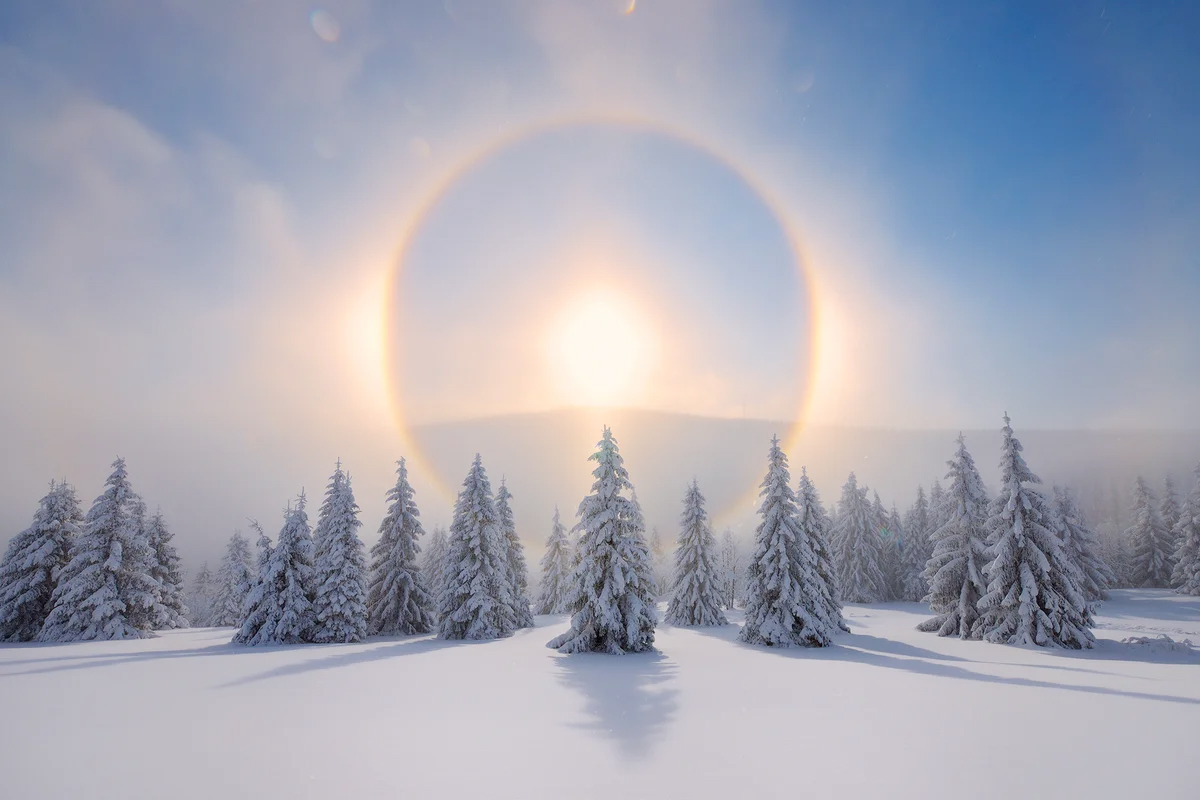 Meet the Halo: Nature’s Sky Ring
One of the most common and eye-catching of these phenomena is the 22-degree halo, a circular band of light encircling the sun at a radius of about 22 degrees. To visualize that, extend your arm and measure two fists' width from the sun. That’s roughly where you’ll see the ring.Though halos are technically illusions—optical effects rather than tangible objects—they can look strikingly real, sometimes faint and ghostly, other times intensely bright. Their appearance is caused by light refracting through column-shaped hexagonal ice crystals, similar in shape to a pencil. As sunlight passes through these columns, it bends by at least 22 degrees, creating the ring effect we see. Because some crystals bend light at slightly wider angles, the halo often has a crisp inner edge and a softer, more diffuse outer glow. While halos are mostly white, they can occasionally show colors—red on the inner edge and blue on the outer—thanks to the way different wavelengths of light refract slightly differently.The thinner and icier the cloud layer, the brighter the halo. Cirrus clouds are often responsible, so if you see wispy, high-altitude clouds overhead, it’s a good time to scan the sky for halos. With enough practice and curiosity, you might start spotting them regularly—some sky watchers have counted hundreds over a lifetime. Halos don’t just form around the sun. The moon can sport one too, though lunar halos tend to be subtler. The contrast of the moon against a dark night sky, however, can make them more noticeable despite their fainter glow.Enter the Sun Dogs: Twin Lights in the Sky
Alongside halos, you may also spot sun dogs, or parhelia, which appear as bright spots flanking the sun at the same 22-degree angle. These are created by flat, hexagonal ice crystals—think of tiny floating floor tiles—that drift down horizontally through the sky.As these crystals fall, air currents help them align horizontally. When sunlight enters and exits their flat faces, the light bends horizontally toward you, producing one or two bright "mock suns" on either side of the halo. Like halos, sun dogs may also show colors—typically red toward the sun and blue on the outer edge. Sun dogs are often brightest when the sun is near the horizon, making early morning and late afternoon prime viewing times. They can be brilliant enough to be mistaken for actual suns, hence their nickname.More Phenomena in the Ice-Crystal Parade
Beyond halos and sun dogs, the sky can host an entire gallery of lesser-known but equally spectacular phenomena. These include: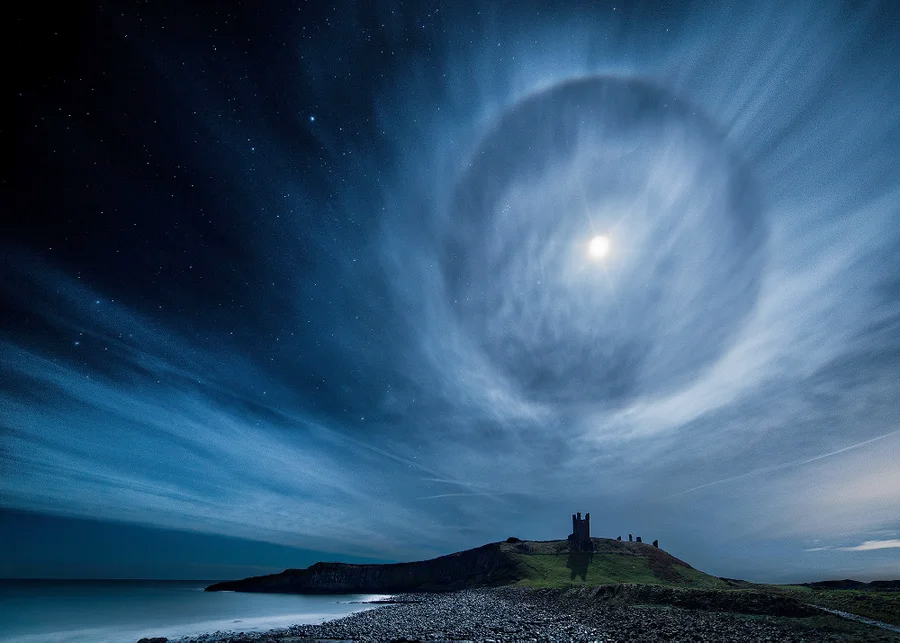 A 22-degree moon halo over Dunstanburgh Castle in Northumberland, England. Credit: Northern Nights Photography/Alamy Stock PhotoThe Elusive Fire Cloud and Light Pillar
One of the rarest sky gems is the circumhorizon arc, sometimes called a fire cloud. This display appears as a flat, rainbow-colored band low in the sky when the sun is high overhead. It’s caused by light entering the vertical side of a flat hexagonal crystal and exiting through its bottom. This unusual path separates the colors even more clearly, creating an eye-catching effect that’s both rare and radiant.Then there’s the light pillar, a vertical shaft of light that appears to rise from the sun—or any bright light source—into the sky. Like sun dogs, they’re caused by flat, plate-shaped crystals. When these crystals hover above a bright light, they reflect its light downward in unison, creating a luminous column that can stretch far into the sky. Light pillars are often seen in cities during cold nights, glowing in hues that match street or holiday lights. A stunning example occurred in Eura, Finland, in 2016, where light pillars reflected the city's streetlights so perfectly that the layout of the city could be traced in the sky.Keep Looking Up
Understanding how these effects form doesn’t lessen their beauty—it enhances it. Knowing what to look for and when increases your chances of witnessing these marvels. And perhaps the most important tip of all? Look up. Most people don’t. And in doing so, they miss out on some of nature’s most beautiful and surprising phenomena. Once you start looking, you’ll begin to see just how many dazzling moments the daytime sky has to offer.
Meet the Halo: Nature’s Sky RingOne of the most common and eye-catching of these phenomena is the 22-degree halo, a circular band of light encircling the sun at a radius of about 22 degrees. To visualize that, extend your arm and measure two fists' width from the sun. That’s roughly where you’ll see the ring.Though halos are technically illusions—optical effects rather than tangible objects—they can look strikingly real, sometimes faint and ghostly, other times intensely bright. Their appearance is caused by light refracting through column-shaped hexagonal ice crystals, similar in shape to a pencil. As sunlight passes through these columns, it bends by at least 22 degrees, creating the ring effect we see. Because some crystals bend light at slightly wider angles, the halo often has a crisp inner edge and a softer, more diffuse outer glow. While halos are mostly white, they can occasionally show colors—red on the inner edge and blue on the outer—thanks to the way different wavelengths of light refract slightly differently.The thinner and icier the cloud layer, the brighter the halo. Cirrus clouds are often responsible, so if you see wispy, high-altitude clouds overhead, it’s a good time to scan the sky for halos. With enough practice and curiosity, you might start spotting them regularly—some sky watchers have counted hundreds over a lifetime. Halos don’t just form around the sun. The moon can sport one too, though lunar halos tend to be subtler. The contrast of the moon against a dark night sky, however, can make them more noticeable despite their fainter glow.Enter the Sun Dogs: Twin Lights in the Sky
Alongside halos, you may also spot sun dogs, or parhelia, which appear as bright spots flanking the sun at the same 22-degree angle. These are created by flat, hexagonal ice crystals—think of tiny floating floor tiles—that drift down horizontally through the sky.As these crystals fall, air currents help them align horizontally. When sunlight enters and exits their flat faces, the light bends horizontally toward you, producing one or two bright "mock suns" on either side of the halo. Like halos, sun dogs may also show colors—typically red toward the sun and blue on the outer edge. Sun dogs are often brightest when the sun is near the horizon, making early morning and late afternoon prime viewing times. They can be brilliant enough to be mistaken for actual suns, hence their nickname.More Phenomena in the Ice-Crystal Parade
Beyond halos and sun dogs, the sky can host an entire gallery of lesser-known but equally spectacular phenomena. These include:
- Tangent arcs: Gull-wing-shaped arcs perched atop halos.
- Parhelic circles: Horizontal white lines extending around the sky, intersecting sun dogs and sometimes giving them a teardrop shape.
- Circumzenithal arcs: Vibrant, upside-down rainbows directly overhead, often described as the "smile in the sky."
A 22-degree moon halo over Dunstanburgh Castle in Northumberland, England. Credit: Northern Nights Photography/Alamy Stock PhotoThe Elusive Fire Cloud and Light PillarOne of the rarest sky gems is the circumhorizon arc, sometimes called a fire cloud. This display appears as a flat, rainbow-colored band low in the sky when the sun is high overhead. It’s caused by light entering the vertical side of a flat hexagonal crystal and exiting through its bottom. This unusual path separates the colors even more clearly, creating an eye-catching effect that’s both rare and radiant.Then there’s the light pillar, a vertical shaft of light that appears to rise from the sun—or any bright light source—into the sky. Like sun dogs, they’re caused by flat, plate-shaped crystals. When these crystals hover above a bright light, they reflect its light downward in unison, creating a luminous column that can stretch far into the sky. Light pillars are often seen in cities during cold nights, glowing in hues that match street or holiday lights. A stunning example occurred in Eura, Finland, in 2016, where light pillars reflected the city's streetlights so perfectly that the layout of the city could be traced in the sky.Keep Looking Up
Understanding how these effects form doesn’t lessen their beauty—it enhances it. Knowing what to look for and when increases your chances of witnessing these marvels. And perhaps the most important tip of all? Look up. Most people don’t. And in doing so, they miss out on some of nature’s most beautiful and surprising phenomena. Once you start looking, you’ll begin to see just how many dazzling moments the daytime sky has to offer.