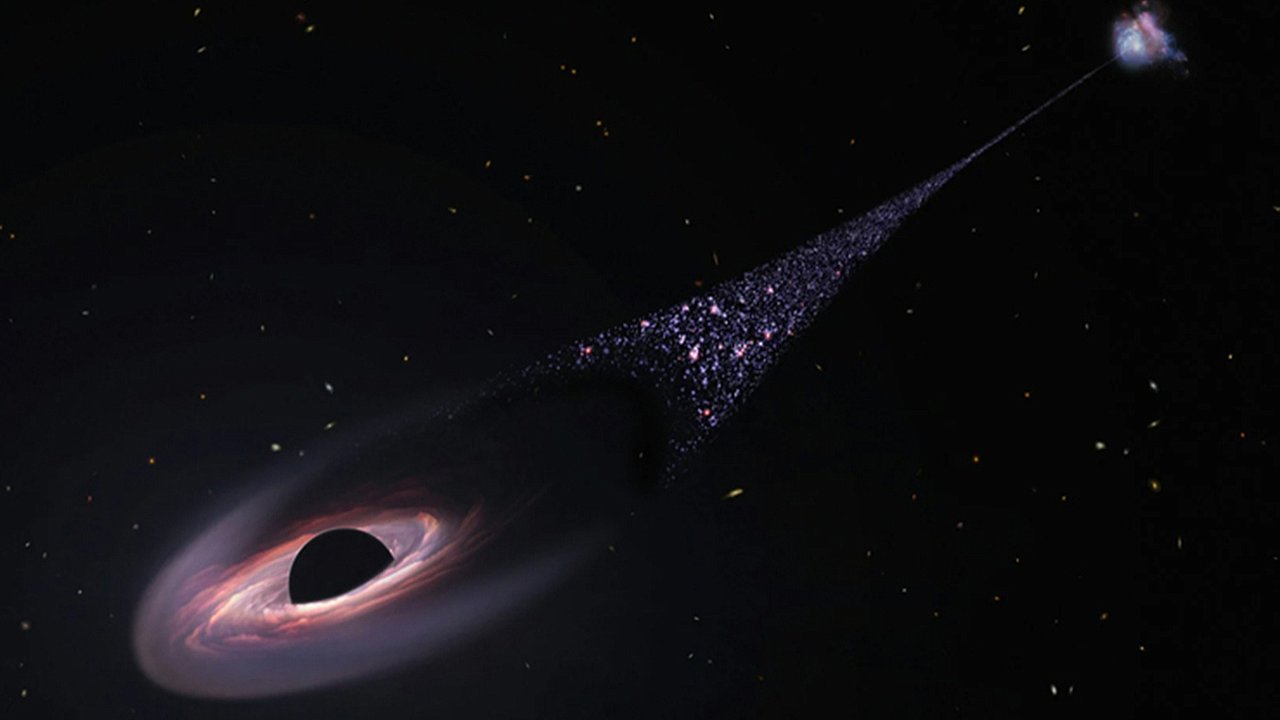
Black holes are among the most mind-boggling phenomena in the cosmos. These invisible giants warp space and time, swallowing anything that dares to come too close — even light itself. Although they can’t be seen directly, astronomers detect their presence through the powerful gravitational influence they exert on nearby stars and gas. When matter spirals toward them, it heats up and emits X-rays, which reveal their lurking locations in the dark. The first such discovery was Cygnus X-1 in 1964, found in the constellation Cygnus. But as incredible as that sounds, black holes are even stranger than science fiction could ever imagine. They distort time, influence the birth of stars, and might even eject matter across galaxies. Here are seven mind-bending facts about black holes that will make you rethink everything you know about space.1. Black holes distort time and space
If you approached a black hole, the immense gravity would stretch time and twist space itself. Near the event horizon — the “point of no return” — time would appear to slow almost to a stop compared to distant observers. Inside this boundary, all paths lead inward toward the singularity, an infinitely dense point where our current understanding of physics collapses. Anything crossing this limit would be stretched into a long strand — a process called “spaghettification” — before being obliterated in a region where gravity reigns supreme.2. Black holes come in many sizes
Not all black holes are created equal. The most common are stellar-mass black holes, which form when massive stars collapse after a supernova explosion. These typically have around ten times the mass of our Sun.
Then there are supermassive black holes, the giants that sit at the centers of galaxies — including our own Milky Way’s Sagittarius A* (Sgr A*), which has a mass equivalent to about four million suns. Scientists are still trying to understand how these cosmic monsters formed so early after the Big Bang.
At the other end of the spectrum are primordial black holes, hypothetical tiny versions that may have formed moments after the Big Bang. Some could be smaller than atoms but pack the mass of an asteroid. Though yet unobserved, they may be scattered throughout the universe, waiting to be discovered.3. There are countless black holes in the universe
Our Milky Way alone may contain between 10 million and one billion stellar-mass black holes — plus the massive Sgr A* at its core. Multiply that by roughly 100 billion galaxies in the observable universe, and the total number of black holes becomes nearly impossible to comprehend. It’s safe to say the cosmos is absolutely filled with these gravitational monsters, each quietly shaping its surroundings.4. Black holes consume and eject matter
Contrary to popular belief, black holes don’t roam the galaxy devouring everything in sight. They feed on material that drifts too close — gas, dust, or unlucky stars — pulling them into an orbiting accretion disk. This disk glows brightly in X-rays before the matter finally crosses the event horizon.But black holes don’t just consume — they also eject. Our own Sgr A* has been observed spitting out massive “spitballs” made of gas and dust that never quite made it past the event horizon. These chunks shoot through space at up to 20 million miles per hour. Although rare, one such ejection traveling toward Earth could spell cosmic trouble for our solar system.5. Supermassive black holes create stars
In a strange twist, supermassive black holes don’t just destroy — they also help create. Astronomers have found that when matter escapes from a black hole’s accretion disk, it can form new stars. Sometimes these newborn stars are flung far into intergalactic space, far from their parent galaxies.Research published in Nature also shows that the size of a galaxy’s central black hole determines how long star formation continues. Smaller black holes seem to shut down star formation faster, controlling the number of stars that emerge within a galaxy.6. Humanity has photographed a black hole’s edge
For decades, black holes were purely theoretical — until the Event Horizon Telescope captured the first-ever image of one in 2019. The photo of the supermassive black hole at the center of galaxy Messier 87, nicknamed Powehi, showed a glowing ring of hot gas around a dark center — the event horizon’s shadow.
In 2022, astronomers achieved another milestone by photographing Sagittarius A*, the supermassive black hole at the center of our own Milky Way. These images gave humanity its first direct look at the boundaries of these cosmic enigmas and confirmed Einstein’s predictions about space-time.7. Some black holes seem to align across galaxies
One of the strangest discoveries came from astronomers in South Africa, who found a cluster of galaxies where the jets of multiple supermassive black holes were aligned — as if spinning in sync. The phenomenon, stretching across 300 million light-years, defies current astrophysical models. Scientists believe this alignment could date back to the early universe, hinting that the cosmos might be more interconnected than we ever imagined.
But as incredible as that sounds, black holes are even stranger than science fiction could ever imagine. They distort time, influence the birth of stars, and might even eject matter across galaxies. Here are seven mind-bending facts about black holes that will make you rethink everything you know about space.1. Black holes distort time and spaceIf you approached a black hole, the immense gravity would stretch time and twist space itself. Near the event horizon — the “point of no return” — time would appear to slow almost to a stop compared to distant observers. Inside this boundary, all paths lead inward toward the singularity, an infinitely dense point where our current understanding of physics collapses. Anything crossing this limit would be stretched into a long strand — a process called “spaghettification” — before being obliterated in a region where gravity reigns supreme.2. Black holes come in many sizes
Not all black holes are created equal. The most common are stellar-mass black holes, which form when massive stars collapse after a supernova explosion. These typically have around ten times the mass of our Sun.
Then there are supermassive black holes, the giants that sit at the centers of galaxies — including our own Milky Way’s Sagittarius A* (Sgr A*), which has a mass equivalent to about four million suns. Scientists are still trying to understand how these cosmic monsters formed so early after the Big Bang.
At the other end of the spectrum are primordial black holes, hypothetical tiny versions that may have formed moments after the Big Bang. Some could be smaller than atoms but pack the mass of an asteroid. Though yet unobserved, they may be scattered throughout the universe, waiting to be discovered.3. There are countless black holes in the universe
Our Milky Way alone may contain between 10 million and one billion stellar-mass black holes — plus the massive Sgr A* at its core. Multiply that by roughly 100 billion galaxies in the observable universe, and the total number of black holes becomes nearly impossible to comprehend. It’s safe to say the cosmos is absolutely filled with these gravitational monsters, each quietly shaping its surroundings.4. Black holes consume and eject matter
Contrary to popular belief, black holes don’t roam the galaxy devouring everything in sight. They feed on material that drifts too close — gas, dust, or unlucky stars — pulling them into an orbiting accretion disk. This disk glows brightly in X-rays before the matter finally crosses the event horizon.But black holes don’t just consume — they also eject. Our own Sgr A* has been observed spitting out massive “spitballs” made of gas and dust that never quite made it past the event horizon. These chunks shoot through space at up to 20 million miles per hour. Although rare, one such ejection traveling toward Earth could spell cosmic trouble for our solar system.5. Supermassive black holes create stars
In a strange twist, supermassive black holes don’t just destroy — they also help create. Astronomers have found that when matter escapes from a black hole’s accretion disk, it can form new stars. Sometimes these newborn stars are flung far into intergalactic space, far from their parent galaxies.Research published in Nature also shows that the size of a galaxy’s central black hole determines how long star formation continues. Smaller black holes seem to shut down star formation faster, controlling the number of stars that emerge within a galaxy.6. Humanity has photographed a black hole’s edge
For decades, black holes were purely theoretical — until the Event Horizon Telescope captured the first-ever image of one in 2019. The photo of the supermassive black hole at the center of galaxy Messier 87, nicknamed Powehi, showed a glowing ring of hot gas around a dark center — the event horizon’s shadow.
In 2022, astronomers achieved another milestone by photographing Sagittarius A*, the supermassive black hole at the center of our own Milky Way. These images gave humanity its first direct look at the boundaries of these cosmic enigmas and confirmed Einstein’s predictions about space-time.7. Some black holes seem to align across galaxies
One of the strangest discoveries came from astronomers in South Africa, who found a cluster of galaxies where the jets of multiple supermassive black holes were aligned — as if spinning in sync. The phenomenon, stretching across 300 million light-years, defies current astrophysical models. Scientists believe this alignment could date back to the early universe, hinting that the cosmos might be more interconnected than we ever imagined.