When to See the August Full Moon
The Full Moon of August 2025 reaches peak illumination at 07:54 UTC on August 9. However, the Moon will appear nearly full for a few nights before and after this date. During this phase, the Moon remains visible all night long, rising near sunset and setting close to sunrise.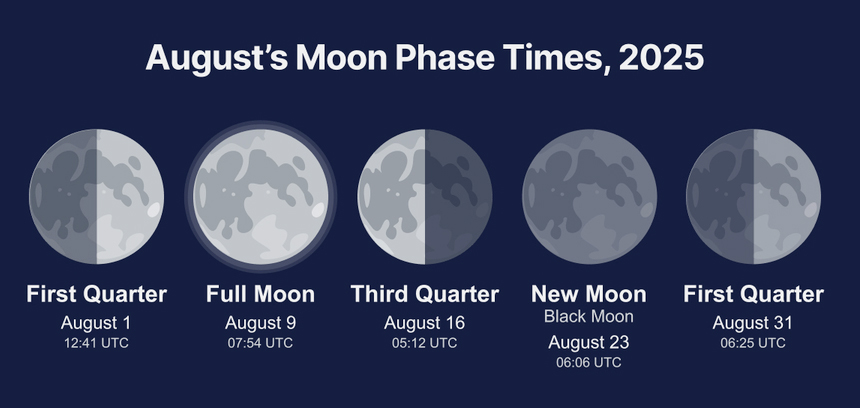 Just two weeks later, on August 23, a Black Moon will occur. This rare event marks the third New Moon in a single astronomical season containing four New Moons.Moon Phases and Timing in August
Primary Moon phases—New Moon, First Quarter, Full Moon, and Last Quarter—occur at exact universal times for everyone worldwide. What changes is the local time and date, which shift depending on the time zone.This is why lunar phase calendars are often tied to a specific city or region; for example, when it’s August 1, 05:00 in New York, it’s still July 31, 23:00 in Honolulu. Similarly, a Moon phase on August 31 in New York may already fall on September 1 in Sydney.Lunar Encounters with Planets
Throughout August, the Moon draws close to several planets and celestial objects:
August 2025 is special because every time zone will experience two First Quarter Moons—a tight timing feat that rarely happens.The lunar cycle averages 29.54 days, meaning a phase can sometimes repeat within a single month. But synchronizing this repetition globally is difficult because time zones can push phases into the previous or following month depending on location.First First Quarter Moon: August 1, 12:41 UTC – In Baker Island (UTC-12), this is 00:41, just 41 minutes into August.Second First Quarter Moon: August 31, 06:25 UTC – In Kiritimati (UTC+14), this is 20:25, only 3.5 hours before September begins.This alignment is possible because the August lunar cycle lasts 29.74 days, about 5 hours longer than usual.Previous Double Phase Events
The last global double-phase event occurred in August 2023, featuring two Full Moons. That cycle lasted only 29.29 days, 6 hours shorter than average, leaving more timing flexibility.
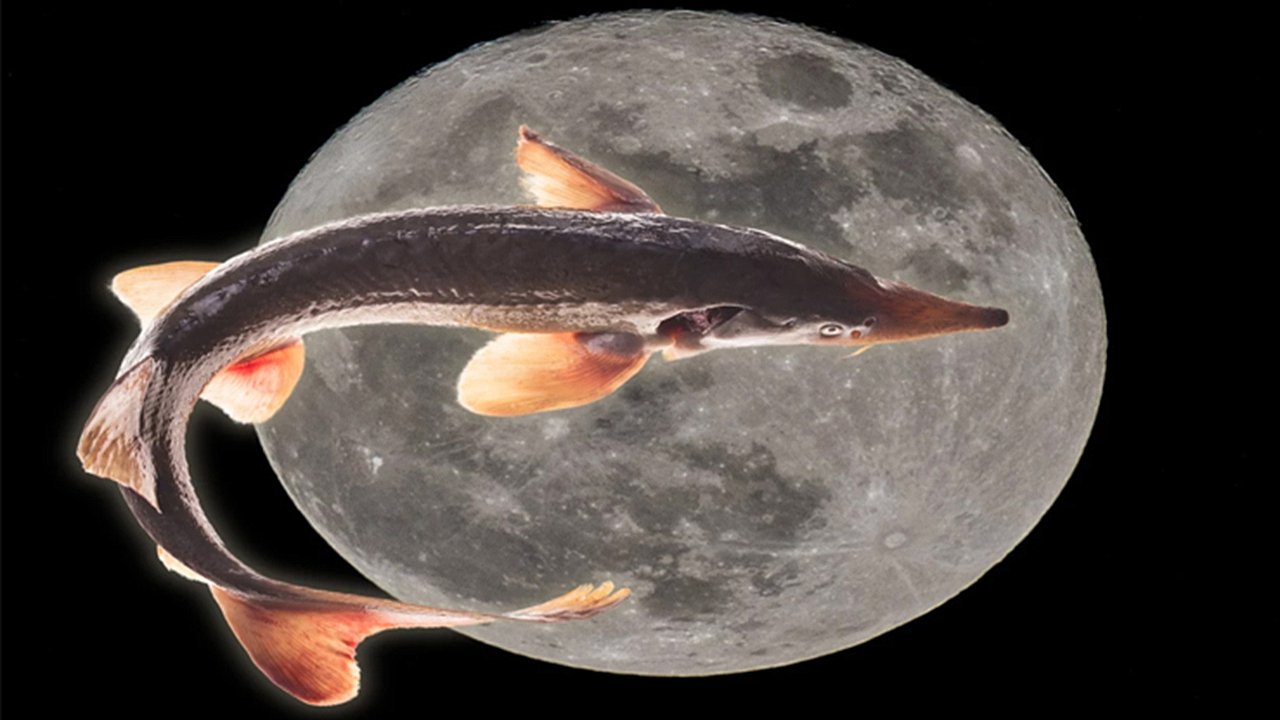
August’s Full Moon is traditionally called the Sturgeon Moon, a name derived from the abundance of sturgeon fish in North America’s Great Lakes during this season. Other historical names include:
The Full Moon of August 2025 reaches peak illumination at 07:54 UTC on August 9. However, the Moon will appear nearly full for a few nights before and after this date. During this phase, the Moon remains visible all night long, rising near sunset and setting close to sunrise.
Just two weeks later, on August 23, a Black Moon will occur. This rare event marks the third New Moon in a single astronomical season containing four New Moons.Moon Phases and Timing in AugustPrimary Moon phases—New Moon, First Quarter, Full Moon, and Last Quarter—occur at exact universal times for everyone worldwide. What changes is the local time and date, which shift depending on the time zone.This is why lunar phase calendars are often tied to a specific city or region; for example, when it’s August 1, 05:00 in New York, it’s still July 31, 23:00 in Honolulu. Similarly, a Moon phase on August 31 in New York may already fall on September 1 in Sydney.Lunar Encounters with Planets
Throughout August, the Moon draws close to several planets and celestial objects:
- Saturn – Around August 12–13, visible in New York, London, and Sydney.
- Jupiter and Venus – A rare three-way approach around August 20, viewable from multiple cities including New York and London.
- Mars – Near the Moon on August 26, seen best from New York and Sydney (London’s bright evenings make it harder to spot).
- Pleiades Star Cluster – On August 16, the Moon passes close to this famous cluster. Unlike July’s occultation visible in North America, August’s occultation will be seen from parts of East Asia.
August 2025 is special because every time zone will experience two First Quarter Moons—a tight timing feat that rarely happens.The lunar cycle averages 29.54 days, meaning a phase can sometimes repeat within a single month. But synchronizing this repetition globally is difficult because time zones can push phases into the previous or following month depending on location.First First Quarter Moon: August 1, 12:41 UTC – In Baker Island (UTC-12), this is 00:41, just 41 minutes into August.Second First Quarter Moon: August 31, 06:25 UTC – In Kiritimati (UTC+14), this is 20:25, only 3.5 hours before September begins.This alignment is possible because the August lunar cycle lasts 29.74 days, about 5 hours longer than usual.Previous Double Phase Events
The last global double-phase event occurred in August 2023, featuring two Full Moons. That cycle lasted only 29.29 days, 6 hours shorter than average, leaving more timing flexibility.
- On Baker Island, the first Full Moon occurred 6.5 hours after August began.
- In Kiritimati, the second Full Moon happened 8.5 hours before month’s end.
August’s Full Moon is traditionally called the Sturgeon Moon, a name derived from the abundance of sturgeon fish in North America’s Great Lakes during this season. Other historical names include:
- Grain Moon
- Corn Moon
- Lynx Moon
- Lightning Moon