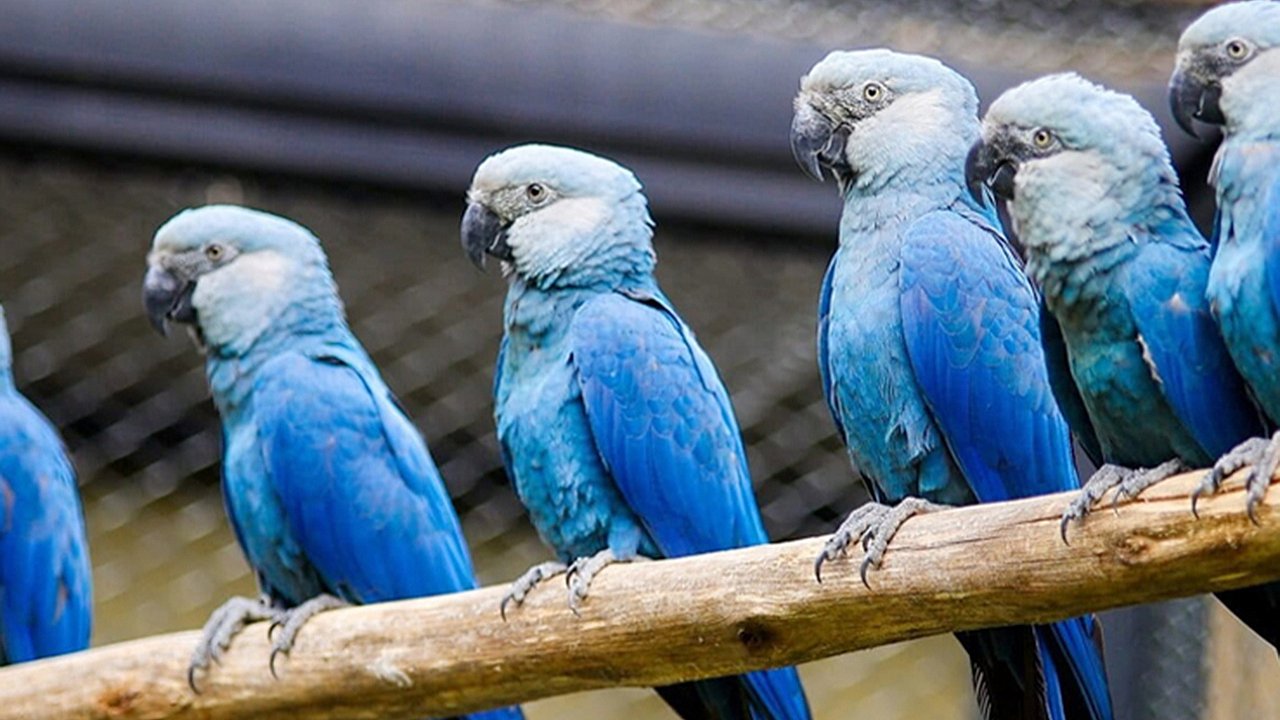
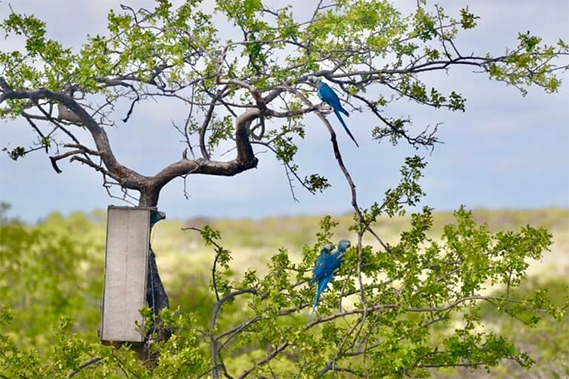
From extinction in the wild to new life in BrazilThe Spix’s macaw, known for its stunning blue plumage and tragic disappearance from the wild, is writing a new chapter in its stormy history. Declared extinct in the wild by the IUCN in 2019, the species was long considered a conservation symbol of loss. But in 2022, years of captive breeding efforts finally bore fruit when 20 Spix’s macaws were reintroduced into the semiarid Caatinga biome of northern Brazil.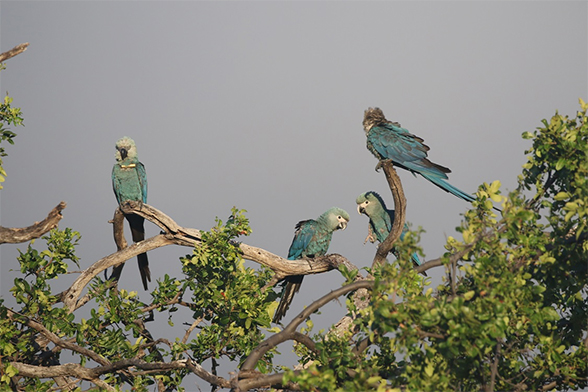 Spix’s macaws hang out in the tree canopy in rural Curaçá municipality, the site of the species’ return to the wild decades after having disappeared. Image courtesy of Cromwell Purchase/ACTP.This year brought another breakthrough: in May, conservationists announced that two wild-born fledglings had successfully taken flight in Bahia’s Curaçá municipality. It was the first time in decades that Spix’s macaws were recorded flying free with their parents. For many experts, this was a turning point, demonstrating that careful planning, training, and monitoring could revive a species once thought gone forever. Yet, even as the skies of Caatinga filled with new life, political and administrative challenges cast doubt on the long-term future of this ambitious project.How the Spix’s macaw disappeared from the wildThe Spix’s macaw (Cyanopsitta spixii) was first described in 1832, based on a specimen collected by German naturalist Johann Baptist Ritter von Spix. Native to the Caatinga region, the parrot’s numbers plummeted over the 20th century, driven by habitat destruction and the booming illegal pet trade that targeted exotic birds.By the late 1980s, only three individuals were known to survive in the wild. In 1990, just one male remained, pairing with a blue-winged macaw, a different species. His lonely story captured worldwide attention, and in 2000 he disappeared, marking the end of the species in nature. For nearly two decades, the Spix’s macaw survived only in captivity, scattered across collections in Germany, Brazil, and Qatar, until coordinated conservation efforts began to focus on its reintroduction.The ambitious reintroduction programThe turning point came in 2019, when Brazil’s Chico Mendes Institute for Biodiversity Conservation (ICMBio) signed a five-year agreement with the Association for the Conservation of Threatened Parrots (ACTP), based in Germany. Under the partnership, ACTP transferred 52 birds to Brazil, where a specialized breeding and release facility was built in Curaçá.
 In June 2022, the first batch of 20 Spix’s macaws was released. The project used innovative techniques to increase success, including training birds in flight and foraging skills and introducing them alongside blue-winged macaws. These “mentor birds” helped the captive-bred Spix’s adapt to the wild, teaching them survival behaviors that would otherwise have been difficult to learn.By the end of the first year, survival rates were over 58%, a significant achievement compared to other parrot reintroductions. Even more encouraging, several pairs formed, and one produced chicks in the wild just a year after release, showing that the population could sustain itself.Wild hatchlings signal progressIn 2023, the first two wild chicks were born but tragically died before they could fly. Learning from this, conservationists intervened more closely in the following breeding attempts. By 2024, their efforts paid off: two strong fledglings successfully left the nest in May, joining their parents in the canopy.For experts like Ugo Vercillo, director of Blue Sky Caatinga, the moment was groundbreaking. “This morning I woke up to a photo of the chicks already on top of a catingueira tree, playing with their mother,” he said. These young macaws represent not just survival, but a potential pathway to a stable wild population.Clouds of uncertainty over the programDespite biological success, the project faces serious administrative hurdles. In May 2024, ICMBio announced it would not renew its cooperation agreement with ACTP, raising doubts about the continuity of releases. Without the agreement, funding, logistics, and technical coordination could unravel, threatening the delicate recovery of the species.
 Experts emphasize that stability is essential. Population models suggest the Spix’s macaw needs at least 700–800 individuals in the wild to be secure over the next century. To reach that number, conservationists planned to release about 20 birds annually for two decades. Interruptions could jeopardize that goal, leaving the species vulnerable once again.Conservation lessons and global significanceThe Spix’s macaw reintroduction has already been called the most successful parrot recovery effort ever attempted. International experts highlight its innovative use of surrogate species, its careful genetic planning, and the level of cooperation between institutions. The project also underscores the challenges of long-term conservation, where biological triumphs can be undone by administrative or political breakdowns.For Brazil, the species carries deep symbolic weight. Known locally as “ararinha-azul,” it represents both the fragility and resilience of the Caatinga biome. Its recovery offers hope not only for parrots but for broader biodiversity conservation in one of the country’s most threatened ecosystems.The fragile road aheadThe story of the Spix’s macaw is one of near extinction, rediscovery, and fragile hope. With wild-born chicks now flying free for the first time in decades, the species has a real chance at revival. But without strong partnerships, continued releases, and sustained investment, the progress could unravel.For now, the bright blue flash of the Spix’s macaw over Bahia’s skies is a testament to what conservation science can achieve. The challenge ahead is ensuring that this comeback story does not end with a second disappearance.
Spix’s macaws hang out in the tree canopy in rural Curaçá municipality, the site of the species’ return to the wild decades after having disappeared. Image courtesy of Cromwell Purchase/ACTP.This year brought another breakthrough: in May, conservationists announced that two wild-born fledglings had successfully taken flight in Bahia’s Curaçá municipality. It was the first time in decades that Spix’s macaws were recorded flying free with their parents. For many experts, this was a turning point, demonstrating that careful planning, training, and monitoring could revive a species once thought gone forever. Yet, even as the skies of Caatinga filled with new life, political and administrative challenges cast doubt on the long-term future of this ambitious project.How the Spix’s macaw disappeared from the wildThe Spix’s macaw (Cyanopsitta spixii) was first described in 1832, based on a specimen collected by German naturalist Johann Baptist Ritter von Spix. Native to the Caatinga region, the parrot’s numbers plummeted over the 20th century, driven by habitat destruction and the booming illegal pet trade that targeted exotic birds.By the late 1980s, only three individuals were known to survive in the wild. In 1990, just one male remained, pairing with a blue-winged macaw, a different species. His lonely story captured worldwide attention, and in 2000 he disappeared, marking the end of the species in nature. For nearly two decades, the Spix’s macaw survived only in captivity, scattered across collections in Germany, Brazil, and Qatar, until coordinated conservation efforts began to focus on its reintroduction.The ambitious reintroduction programThe turning point came in 2019, when Brazil’s Chico Mendes Institute for Biodiversity Conservation (ICMBio) signed a five-year agreement with the Association for the Conservation of Threatened Parrots (ACTP), based in Germany. Under the partnership, ACTP transferred 52 birds to Brazil, where a specialized breeding and release facility was built in Curaçá.In June 2022, the first batch of 20 Spix’s macaws was released. The project used innovative techniques to increase success, including training birds in flight and foraging skills and introducing them alongside blue-winged macaws. These “mentor birds” helped the captive-bred Spix’s adapt to the wild, teaching them survival behaviors that would otherwise have been difficult to learn.By the end of the first year, survival rates were over 58%, a significant achievement compared to other parrot reintroductions. Even more encouraging, several pairs formed, and one produced chicks in the wild just a year after release, showing that the population could sustain itself.Wild hatchlings signal progressIn 2023, the first two wild chicks were born but tragically died before they could fly. Learning from this, conservationists intervened more closely in the following breeding attempts. By 2024, their efforts paid off: two strong fledglings successfully left the nest in May, joining their parents in the canopy.For experts like Ugo Vercillo, director of Blue Sky Caatinga, the moment was groundbreaking. “This morning I woke up to a photo of the chicks already on top of a catingueira tree, playing with their mother,” he said. These young macaws represent not just survival, but a potential pathway to a stable wild population.Clouds of uncertainty over the programDespite biological success, the project faces serious administrative hurdles. In May 2024, ICMBio announced it would not renew its cooperation agreement with ACTP, raising doubts about the continuity of releases. Without the agreement, funding, logistics, and technical coordination could unravel, threatening the delicate recovery of the species.Experts emphasize that stability is essential. Population models suggest the Spix’s macaw needs at least 700–800 individuals in the wild to be secure over the next century. To reach that number, conservationists planned to release about 20 birds annually for two decades. Interruptions could jeopardize that goal, leaving the species vulnerable once again.Conservation lessons and global significanceThe Spix’s macaw reintroduction has already been called the most successful parrot recovery effort ever attempted. International experts highlight its innovative use of surrogate species, its careful genetic planning, and the level of cooperation between institutions. The project also underscores the challenges of long-term conservation, where biological triumphs can be undone by administrative or political breakdowns.For Brazil, the species carries deep symbolic weight. Known locally as “ararinha-azul,” it represents both the fragility and resilience of the Caatinga biome. Its recovery offers hope not only for parrots but for broader biodiversity conservation in one of the country’s most threatened ecosystems.The fragile road aheadThe story of the Spix’s macaw is one of near extinction, rediscovery, and fragile hope. With wild-born chicks now flying free for the first time in decades, the species has a real chance at revival. But without strong partnerships, continued releases, and sustained investment, the progress could unravel.For now, the bright blue flash of the Spix’s macaw over Bahia’s skies is a testament to what conservation science can achieve. The challenge ahead is ensuring that this comeback story does not end with a second disappearance.